

































Welcome
to One
Fish at
a Time –
an
environmental
education
resource
for
children
and
young
adults
focused
on fish
and
aquatic
ecosystem
conservation.
Throughout
this
site,
you’ll
find
fun,
interesting,
educational
and
inspirational
games,
activities,
facts
and tips
as well
as
real-life
opportunities
to
conserve,
protect
and
explore
the
underwater
world.
You may
even
become
famous
by being
the
first
person
in the
world to
make a
real-life
underwater
discovery
using a
real-time
underwater
fish
monitoring
network. Our goal
is to
inspire
everyone
to
appreciate,
respect,
conserve
and
protect
fish and
their
aquatic
habitat.
Please
help us
get
funding
from
Shell
Canada
through
their
fuelling
change
program. Visit
http://www.fuellingchange.com
to vote
now for
One Fish
at a
Time!
Follow us on:
Sponsor Company name
Fish Facts
There are more fish species than the combined total of all other vertebrates; mammals, amphibians, reptiles and birds.
The study of fish is called "Ichthyology".
Fish have been on earth for more than 450 million years.
The "Platinum Arowana", a silver arowana bred for reduced pigmentation (leucism), is considered to be the most expensive aquarium fish in the world. A Singapore based fish breeder claims to have rejected an offer as high as $80,000 dollars.
Some species of fish have skeletons made only of cartilage.
The largest fish in the world is the whale shark which can reach 50 feet in length.
Some species of fish can fly (glide) others can skip along the surface and others can even climb rocks.
Fish have a specialized sense organ called the "lateral line" which works much like ears and helps them navigate in dark or murky waters.
Fish have excellent sense of sight, touch, taste and many posses a good sense of smell and hearing.
Fish are divided into three main groups; skeletal, cartilaginous and jawless.
According to FishBase.com 250 new species of fish are officially described by scientists each year. 31000 species of fish had been described by April 2009.
The practice of ichthyology is associated with marine biology and limnology.
Limnology is the study of inland waters, such as lakes, streams and rivers.
Marine biology is the study of living things in the ocean or other marine or brackish water.
The study of fish began in the late Stone Age over 10,000 years ago.
Aristotle incorporated ichthyology into formal scientific study creating the first taxonomic list of fish, in which 117 Mediterranean fish were described.
Emperor Akihito of Japan is an avid ichthyologist, and even has a small goby fish named after him called the Akihito vanuatu.
The same genes involved in tooth and hair development in mammals are also involved in fish scale development.
Stroking a shark from head to tail produces a smooth feeling yet stroking the skin in the opposite direction reveals a rough texture.
Some people use shark skin as sand paper.
40% of all fish species live in fresh water yet less than 0.1% of the earth’s surface is fresh water.
Fish were the first vertebrates to evolve.
Fish are typically cold blooded (ectothermic), meaning that they must absorb heat from their surroundings.
The word fish is described as any non-vertebrate that has gills throughout its life and has limbs in the shape of fins.
Fish speed is calculated in body lengths per second. Fast swimmers are able to reach 10-20 lengths per second and those slower but more maneuverable reach no more than 0.5 lengths per second.
A seahorse IS a fish, while shellfish, crayfish, cuttlefish, jellyfish and starfish are NOT fish.
There are fish that spend most of the time out of the water. Mudskippers feed and interact with each other on mudflats and are only underwater when hiding in their burrows.
Salmon live in the ocean but swim upriver against strong currents to spawn. The journey can take up to six months resulting in far more salmon dying during migration.
The American eel breeds in the ocean but spends most of its life in freshwater streams.
A salmon can find its birthplace with highly developed senses that allow it to recognize the temperature, smell and chemical make-up of the water it was born in.
Over 500 million years ago the agnathans or “fish without jaws” were the first vertebrates to evolve.
During reproduction a female salmon will lay approximately 450 to 800 eggs per pound or .5 kilograms of its bodyweight.
Before migration to the mating grounds the male salmon’s lower jaw develop a hook like “weapon” to be used in combat between males over females during mating rituals.
Some scientists believe that salmon use their sense of smell during migration to find their bearings using the earth’s magnetic field as birds do.
During migration salmon usually travel 200-300 kilometers, taking 6 months or longer to make the trip.
Salmon can jump 2 meters high and 4 meters in length.
Salmon nests measure about one meter in length and 5 - 10 cm in depth.
The Greek word for fish is “Ichthys” this is why the study of fish is called “ichthyology”.
There is a threat of overfishing of edible fishes such as cod and tuna. If overfishing persists, it eventually causes a collapse of the fish population (known as stock).
Many types of fish migrate on a regular basis; from daily to annual and over distances ranging from a few meters to thousands of kilometers.
Fish that migrate within freshwater only are called “potamodromous”, from the Greek word “river running”.
Fish that migrate in saltwater only are called “oceanodromous”.
Fish such as salmon that migrate between salt water and fresh are called “diadromous”.
Fish that live in the ocean mostly and breed in fresh water are called “anadromous”, from the Greek word “ana” meaning up. Salmon is an example of an anadromous fish.
Catadromous fish live in fresh water and breed in the ocean, from the Greek word “cata” or down.
Amphidromous fish, from the Greek word “Amphi” meaning both, move between fresh and salt water during their life cycle but not to breed.
Forage fish migrate great distances in a triangle between their spawning, feeding, and nursery grounds. For example, one stock of herring spawn in southern Norway, have their feeding grounds in Iceland and nursery grounds in northern Norway.
If a fish species is referred to as “pelagic” it means that they spend most of their lives in the open ocean and do not live near the ocean floor.
A “demersal“ fish is a fish that feeds off or near the bottom of a deep lake or ocean.
There are five species of pacific salmon; Chinook (King) Coho (silver), Sockeye (red), Chum (dog), and Pink (humpback).
Pacific salmon hatch in small freshwater streams. From there they migrate to the sea to mature for two to six years before returning to the same stream to spawn themselves.
Salmon are capable of traveling hundreds of kilometers upriver so humans must install fish ladders in dams to enable salmon to get past.
Diel vertical migration is the daily pattern of movement of fish to the surface at night to feed, and then return to the depths during daytime.
A large number of marine fishes such as the tuna migrate north and south annually, following temperature variations in the ocean.
Fish Ladders are also known as fish steps, fish ways, or a fish pass. They are designed to assist in the diadromous fish’s natural migration.
Fish ladders are carefully designed by scientists, and the speed of the water over the steps has to be enough to attract the fish but not enough to wash them away.
Written reports of rough fishways date back to 17th century France, where bundles of branches were used to create steps in steep channels to bypass obstructions.
In 1837 the first patent was issued to Richard McFarlan of Bathurst New Brunswick for a fishway designed to bypass a dam at his water powered lumber mill.
There are five main types of fishways:
1. Pool and weir
2. Baffle, such as Denil, or Alaskan steepass
3. Fish Elevator
4. Rock ramp fishway
5. Vertical slot
In Holyoke Massachusetts on the Connecticut river a fish elevator lifts up to 500 fish at a time 52 feet to clear the Holyoke dam. Built in 1955 the Holyoke fish elevator annually lifts more than 500,000 fish per year.
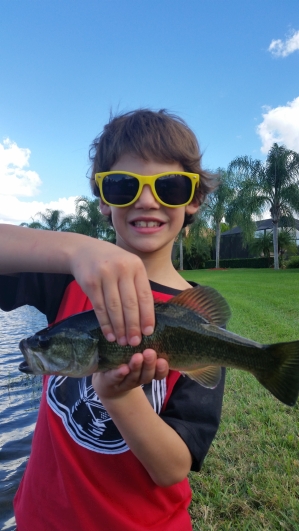
Largemouth bass are members of the sunfish family. They are also called widemouth bass, bucketmouth bass and bigmouth bass. They derive their name from the large mouth that that extends beyond the rear of the eye.
The Largemouth bass scientific name is “Micropterus salmoides” (my-CROP-ter-us Sal-MOY-dees) it is the largest of the black basses and can live 16 years on average.
Juvenile Largemouth bass eat mostly small baitfish, scuds and insects. As adults they prey on smaller fish, crayfish, frogs, snakes, salamanders, bats, small water birds, mammals and even baby alligators that can be as large as 25 -35 % of the bass’s body length.
Largemouth bass respond well to catch and release fishing. Studies have shown some having survived being caught and released a number of times.
The scientific name for the Smallmouth bass is “Micropterus dolomieui” (my-crop-ter-us Dol-o-me-wi.
There are approximately 30,000 species of fish. There may be 10,000 more yet to be found.
Fish such as lampreys and hagfishes that have sucking mouths are the most primitive fish-like animals.
The world’s smallest fish is the “Paedocypris progenetica”, and is in the minnow family. It grows only to 7.9 millimeters long and survives in forest swamps on the Indonesian island of Sumatra.
The age of fish is determined by either counting growth rings on scales, and/or rings found in otoliths (small bones of the inner ear). Similar to counting rings of a tree, the rings resemble seasonal changes in the environment.
Many fish such as several kinds of sharks don’t lay eggs and give birth to live young.
Fish swim by contracting bands of muscles on alternate sides of the body to whip the tail back and forth. The dorsal, pectoral and pelvic fins are used primarily for stability.
Tunas and some sharks are champions of speed and can reach short burst speeds of 50 miles per hour.
The average discharge of an electric eel is more than 350 volts, but discharges as high as 650 volts have been measured.
Deep water lobsters found out on the continental shelf migrate in a seasonal pattern, coming closer to shore in the summer and returning to deep water in the fall. Distances of up to 225 miles have been recorded being traveled in this migration.
The largest clam in the world is the geoduck (pronounced gooey-duck) clam and can weigh on average up to three pounds.
Cone shells are a tropical species of snail that are highly venomous and can even be fatal to people. The poison is injected through a spear shaped rod called a radula into the food item to immobilize it for digestion.
The Kemps Ridely turtle is not only the smallest sea turtle in the world weighing around 80-100 pounds, it is also the rarest.
Sharks have 8 senses. These are hearing, smell, lateral line, pit organs, vision, Lorenzini (special organs that sense electric fields), touch, and taste.
Most of the larger whales have very low reproductive rate with females only having a single calf every 2-4 years. This low reproduction rate means long time periods for some whales to rebound from low population levels.
When sea turtles are active, they must swim to the ocean surface to breathe every few minutes. When they are resting, they can remain underwater for as long as 2 hours.
The leatherback is the largest sea turtle. Individuals can grow to a shell length of 1.85 meters (6 feet) and weights of 637 kilograms (1,400 pounds). Their shells are covered in a rubbery skin with seven longitudinal ridges.
The spotted climbing perch is able to absorb oxygen from the air and will crawl overland using its strong pectoral fins.
The male Bangaii Cardinal will hold both eggs and babies in his mouth until the young are ready to go on their own. This process is known as "mouth brooding," and although it takes several weeks, the fish will not eat until the eggs hatch.
Catfish have over 27,000 taste buds. Humans have only 9,000 taste buds.
Most people would not even think to kiss a fish, even though many brands of lipstick contain fish scales.
Members of the pufferfish family (also called fugu), which has species mostly in tropical saltwater but also a few in cooler and freshwater habitats, is the most poisonous fish in the world. The neurotoxin it produces, tetrodotoxin, is 1500 times more deadly than cyanide.
Octopuses have 3 hearts.
Starfish have eight eyes, with one at the end of each leg. They are used to sense light, but are not sophisticated enough to allow them to see images as we do with our eye.
When a great white sinks its teeth into its prey, it bites with a force equivalent to 1.8 tons. This is 20 times the force a human bite can produce (176 pounds).
Some species of fish start out their lives as one sex and can change into another later in life, this is called a ‘sequential hermaphrodite’.
Ocellaris clownfish (Amphiprion ocellaris), are all born male and live in a group with a single dominant female. If the dominant female dies or is removed, then the dominant male will turn into the new dominant female.
There are more venomous species of fish than venomous snakes. We currently know about 600 species of venomous snakes and 1200 species of venomous fish, with more to be discovered.
Approximately 50 000 people are poisoned by fish in some way each year, with symptoms ranging from a blister to death. They’re found all over the world and in all habitats. Some of the best known venomous fish include species of lionfish, catfish, scorpionfish, pufferfish, toadfish, and stonefish.
According to a study by the WHO, 1 billion people throughout the world rely on fish and other seafood for their main source of animal protein, with most island nations such as Iceland and Japan using it as their sole source of animal protein.
Engineers at MIT and the US Navy have studied the tuna in order to design faster and more efficient submarines.
According to the International Shark Attack File, your odds of being attacked by a shark are 1 in 11.5 million and your odds of actually dying are 1 in 264 million; you are more likely to randomly choose the prime minister out of the entire population of Canada (1 in 33 million), drown in your bathtub (1 in 800 000) or die from falling down the stairs (1 in 200 000).
Sharks are worshipped in Ancient Hawaiian mythology; Ka-moho-ail’i is the name of the shark god of Hawaiian mythology who helped guide his younger sister Pele to the islands.
The Japanese use sharkskin to make wasabi graters, as well as the hilts of traditional swords.
The largest carnivorous fish known to have ever existed is the megalodon, a prehistoric ancestor to modern day sharks. It lived 18 – 1.5 million years ago, is believed to have reached lengths of 20.3 m (67 ft) and likely preyed on whales.
After reading Peter Benchely’s book Jaws in preparation for filming the famous movie, Steven Spielberg said that he had wanted the shark to win.
After seeing how sharks had become unfairly persecuted in real life following the success of Steven Spielberg’s film Jaws, the author of the original book, Peter Benchley became a dedicated ocean conservationist.
The largest living fish species in the world is the whale shark. The largest confirmed individual was measured at 13 m (42 ft) and weighed 21.5 tons (47 000 lb), but there are probably larger ones out there.
The first fish to evolve about 530 million years ago had no jaws or paired fins and their eyes were very simple eyespots that could only detect light. Their closest modern living descendents are lampreys and hagfish.
The first bony fish evolved 418 million years ago. By comparison, the first dinosaurs appeared 230 million years ago.
The Guinness Book of World Records lists the oarfish as being the longest bony fish in the world, currently living bony fish measured at 11 m (36 ft) in length.
The Salmon were such an important food source to the First Nations people of B.C. that they believed in a an immortal tribe known as the Salmon People, who lived at the bottom of the ocean and could change themselves into fish. Legend stated that if they threw the bones of the salmon back into the river after eating them, that the Salmon People would come back to life and thank them by returning the next year for them to eat again.
According to Greek Mythology, Aphrodite and Eros transformed themselves into fish to escape the monster Typhon, tying a cord to the ends of their tails to ensure they didn’t get lost. This is represented in the constellation Pisces.
Ancient people believed that sea dragons and seahorses were baby dragons.
Sharks constantly grow individual replacement teeth that roll forward like a conveyor belt, some species can lose 30 000 teeth in their lifetime.
Sharks are the only fish with eyelids and that can change the size of their pupils.
Sharks use an electroreceptor called the Ampullae of Lorenzini to detect electromagnetic fields, allowing them to find prey hidden in sand and navigate by reading the Earth’s magnetic field.
The Chinese were the first known people to practice aquaculture in 2500 BC.
Goldfish were first selectively bred from carp and kept as pets in the Tang Dynasty around 618 AD.
The belief that goldfish only have a memory of 3 seconds is incorrect. Experiments have shown that they can be trained to swim towards colors, shapes and sounds, push a lever to earn a food reward or navigate a simple maze and have a memory span of at least three months.
A common stunt and initiation trial in college frat houses from the 1930’s to the 1950’s was live goldfish swallowing.
A traditional game at Japanese festivals is goldfish scooping, where people attempt to catch a goldfish using a small plastic frame with paper and place it into a bowl.
The first public aquarium was opened in May 1853 at the London Zoo.
Upon his death in 1995, Benson, a carp in Britain weighed 29 kg (64 lb), was between 20-25 years old and had been caught 63 times.
The most expensive food derived from fish is the caviar of the beluga sturgeon, valued at $25 000 US/kg.
The problem of invasive silver carp jumping out of the water and hitting people has become so widespread in the United States, that the EPA has been tracking injury statistics and advising people to wear helmets when riding in boats and personal watercraft.
In preparation for making the film Finding Nemo, the staff at Pixar visited aquariums, went scuba diving in Australia, kept a 25 gallon fish tank in the office, and received in-house lectures from an ichthyologist from the University of California in order to portray water, swimming fish and coral underwater as accurately as possible.
At an average weight of around 1000 kg (2200 lb), the ocean sunfish is the heaviest bony fish on record.
In 2005, the Ig Nobel Prize was awarded to a group of scientists who proved that herring communicate to each other at night by farting.
Smelt are also known as candlefish because they were so oily that during the 1800s, people dried them out, placed reeds into their bodies and burned them as candles.
Fish use an air-filled organ called a swim bladder to float and stay upright in water.
Sharks use the oil in their livers to stay afloat in water.
Shark liver oil is lighter than water and contains a chemical known as squalene. Squalene is also found in vegetable oils such as olives and rice bran and may have anticancer and antibiotic properties.
Scientists have recently discovered the smallest living shark species, the dwarf lantern shark (Etmopterus perryi) in a small area of the Carribean Sea near Colombia and Venezuela. Its maximum known length is 21.2 cm (8.3 in). The previous record holder was the pygmy shark (Euprotomicrus bispinatus), with a largest known specimen having a length of (10 in).
Sharks have excellent eyesight. Unlike most fish, the pupils in a shark’s eyes can become larger or smaller depending on the amount of light available. A special layer at the back of their eyes known as the tapetum lucidum allows them to see 10 times better than a human in dim light. Their eyes also have rod and cone cells, meaning they can probably see in color.
Even though it is easier to breed goldfish that are yellow, it was forbidden for people who were not royalty in Ancient China to own anything that was yellow, since it was considered the Imperial color of the Emperor. This led them to develop the orange variety we are familiar with today.
Sharks in the family Squaliformes are also called lantern sharks due to their ability to glow in the dark; this ability is called bioluminescence. Scientists are still trying to find out what their bioluminescence is used for, but believe it might be used for camouflage from predators, to attract prey or to attract mates.
The cookiecutter shark (Isistius brasiliensis) is a tiny deep-sea dogfish shark (< 50 cm [20 in]), known for its ability to bite off round, symmetrical pieces of skin and flesh from fish and sea mammals. Its teeth are so powerful that it has also been known to bite and damage the neoprene, rubber and fiberglass on submarines and underwater cables by mistake.
The swellshark (Cephaloscyllium ventriosum) is a medium sized catshark (< 100 cm [39 in]), known for its ability wedge itself into a rocky cave or crevice by gulping in enough water to swell its belly so that predators can’t pull it out and eat it.
Unlike most sharks which replace their teeth one at a time, the cookiecutter shark (Isistius brasiliensis) replaces row of bottom teeth all at once like a set of dentures. It then digests its own teeth because its typical diet of skin, flesh and blubber is so low in calcium that it needs the mineral from its old teeth to make new ones.
Thresher sharks (genus Alophias) have tails which can reach up to 2.1 m (7 ft) that are used to stun prey.
The egg cases of skates, rays and sharks are often called mermaid’s purses. If you find one on the beach with a hole in it, it usually means that the fish has already hatched out.
The bull shark (Carcharhinus leucas) the only known marine sharks that can tolerate fresh water for short periods have been observed swimming 4000 km (2500 mi) up the Amazon River.
In the Solomon Islands, hunters carried carvings that had a shark on one side and a bonito fish on the other. This was done in hope that these charms would repel sharks and attract fish.
The oldest shark fossils that were found in Australia and Antarctica date back to over 400 million years ago. This is long before the first dinosaurs.
Rays are similar to sharks in many ways such as the lack of a swim bladder and rely on a large, buoyant liver. This isn’t suprising since rays have evolved from sharks over 200 million year ago.
Electric rays give predators and prey a jolt of electric shocks to stun them. This is dangerous for divers too whom my inadvertently find themselves zapped.
A ray’s mouth and gills are on the underside of its body. To breath while laying on the seafloor, a ray can draw water through a pair of openings on its head, called spiracles.
Large rays such as the manta ray can leap out of the wwater sometimes as high as 5 feet (1.5 meters).
Manta rays, or devilfish have enormous wings, that can measure up to 23 feet (7 meters) across. This is as wide as four cars.
Cartilage doesn’t contain any blood vessels like bone does.
All newborn sharks are abandoned at birth and left to fend for themselves immediately.
Sharks can go long periods of time without eating. The great white shark can go for months without having to hunt for food.
Baby sharks are born in one of three ways. Some sharks give birth to live young and these sharks are known as viviparous. Other sharks lay eggs on the seafloor after they have been fertilized, and these are known as Oviparous sharks. Lastyl, some sharks do both, and carry the fertilized eggs inside their bodies until they are ready for birth. This last group of sharks are called Ovoviviparous sharks.
There are eight groups of sharks in the world. Although they are all cartilaginous fish, this may be the only thing they have in common with each other.
Sharks have great night vision and see 10 times better than we do in low light.
A shark’s taste is their least-developed sense. A shark has to bite a prey to determine if it is good to eat.
Nostrils of a shark are used only for smelling and not for breathing. As water flows over the nostrils, it brings chemical clues as to what food is nearby.
Electroreception is the rarest of senses. Only sharks and the duck-billed platypus of Australia are thought to have this sense.
Sharks have ears, but you can’t see them. Receptors in the inner ear pick up sounds traveling through the water.
Just like other animals such as squid, fish,worms, crustaceans and mollusks, some sharks can produce light. This phenomenon is called bioluminescence. The lantern shark is a deep water, bottom-dwelling species of shark that utilizes this light ability to attract prey and potential mates.
Finning is the practice of cutting the fins off a shark and throwing its body back into the ocean. Scientists estimate that 38 to 100 million sharks are killed each year for their fins.
Carpet sharks are given this name because almost all members of the this group live on the seafloor. They tend to be sluggish and prefer to wait on prey to come to them.
Carpet sharks are a diverse group of sharks ranging from as small as the one-foot (30 centimeters) barbelthroat to the world’s larges fish the whale shark growing up to 60-foot (18 meters).
The brownbanded bambooshark can spend long periods of time in shallow tidal pools where there are low oxygen levels. This shark is capable of this by simply shutting down nonessential processes to conserve oxygen already in its bloodstream.
Not all sharks are cold-bodied. Makos, great white, thresher, and porbeagle sharks are warm-bodied, which means they can keep their tempersature up even when swimming in cool water.
Sandtiger sharks were the first sharks to become a protected species in 1984, after nearly being hunted to extinction in Australia.
The bull shark is known to swim from saltwater into freshwater rivers. This spectacular animal is known to swim thousands of miles upriver in search of prey.
The largest great white shark ever caught was a female measuring 21 feet (6.4 meters) and weighing a in at 7300 pounds (3311 kilograms). She was caught in 1945 off the coast of Cuba.
The pelvic fins of a fish are paired fins which help with up and down movement.
The operculum is the hard plate covering the sensitive gills of fish (also called the gill cover).
Fish have a slim coat that protects them from parasitic infections, bacteria and disease.
The swim bladder in fish allow them to remain suspended in the water at any depth by filling it with or removing air.
Oceanographers divide the ocean into five broad zones according to how far down sunlight penetrates: epipelagic zone, mesopelagic zone, bathepelagic zone, abyssal zone and hadal zone.
Beneath the Surface of the oceans lie rugged mountains, active volcanoes, vast plateaus and almost bottomless trenches.
The world’s oceans cover approximately 71% of the Earth’s surface.
The average depth of the Earth’s oceans is 12,000 feet (3,720 m).
The deepest point of the oceans is the Mariana Trench in the western Pacific at a depth of 36,198 feet (11,033 m).
Although we have walked on the moon and seen the surface of Mars, we have explored less than 1% of the Earth’s sea floor.
The pressure at greatest depths of the ocean can reach more than 16,000 pounds
per square
inch (the weight of an adult elephant).